Leaderboards
A leaderboard is every scorecard of one protocol (name, version and digest), ranked by success. There is no server:
scorecards are JSON files, and hylo bench leaderboard collects them from directories.
Running policies
--policy takes an agent spec as JSON, an experiment config YAML (its agent is used) or a plugin name:
| Option | Meaning |
|---|---|
--name |
the policy's name on the leaderboard (also the scorecard's file name) |
--out DIR |
runs go to DIR/runs, scorecards to DIR/scorecards (default: the current directory) |
--workers N |
parallel episodes |
--set KEY=VALUE |
execution only: env.remote.* (for example another runtime); anything measured is refused |
--notes TEXT |
stored in the scorecard |
Artifacts in the agent spec are referenced by store id
({"path": "artifact:policy.flow@8d782faf2668f0bd"}), so a scorecard names the exact weights that were scored.
Ranking and comparing
uv run hylo bench leaderboard                          # ./scorecards
uv run hylo bench leaderboard runs/policies/scorecards --json
uv run hylo bench compare scorecards/mujoco-reach/flow-steering-4.json scorecards/mujoco-reach/bc.json
The leaderboard prints one Markdown table per protocol digest: rank, policy, success %, 95% interval, scored
episodes, mean steps. compare prints the paired result:
{
  "candidate": "flow+steering-4",
  "baseline": "bc",
  "n_pairs": 100,
  "candidate_wins": 18,
  "parent_wins": 5,
  "p_value": 0.005311012268066406
}
candidate_wins counts episodes only the candidate solved, parent_wins those only the baseline solved; the
p-value is the one-sided exact McNemar test on them (statistics).
The reference-policy leaderboard
bench/examples/policies/compare.py trains one policy per family from the same demonstrations and scores each under
mujoco-reach:
- data from the development splits only (RFC-0002
searchandsearch_valseeds of thersiprotocol): the IK controller's runs as demonstrations, random-action runs as exploration data for the world model; - one learner per family (
policy.knn,policy.bc,policy.flow,policy.tokens) and a state world model (world_model.state) for MPC, each sealed as an artifact with provenance; - each policy run by an agent (policies):
policy, ACT-styletemporal_ensemble, orsteered(4 seeded samples, the medoid executed), scored on the 100 held-out episodes.
uv run python bench/examples/policies/compare.py --out runs/policies
uv run hylo bench leaderboard runs/policies/scorecards
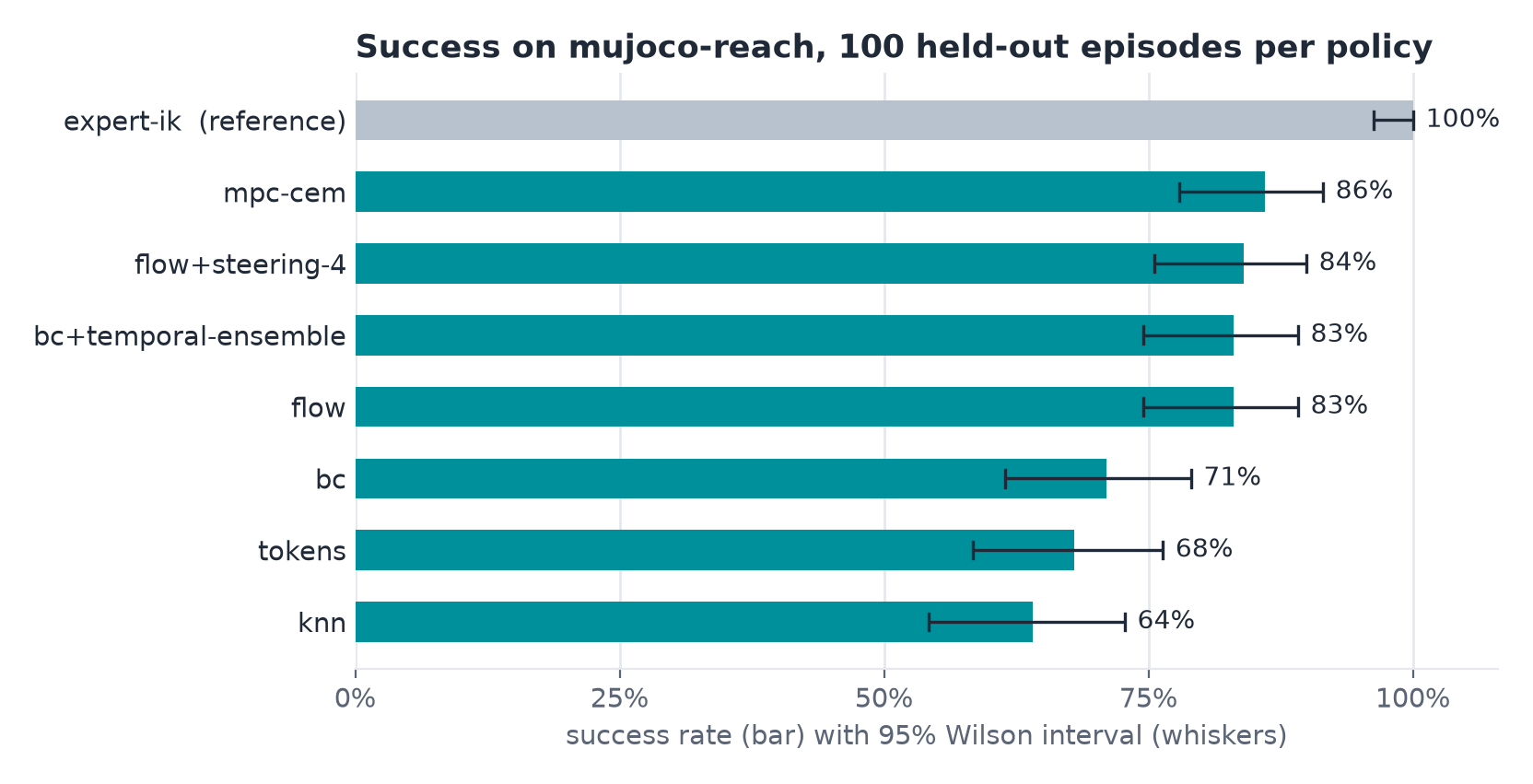
The recorded result (mujoco-reach v1, scorecards with protocol digest 5e0c57ef414a0b21, written before the rename to Hylo; see protocols):
| # | Policy | Agent | Success % | 95% CI | Mean steps |
|---|---|---|---|---|---|
| 1 | expert-ik | baseline.planar_ik (the demonstrator) |
100.0 | 96.3-100.0 | 36 |
| 2 | mpc-cem | policy with policy.mpc (CEM in the learned world model) |
86.0 | 77.9-91.5 | 60 |
| 3 | flow+steering-4 | steered with policy.flow |
84.0 | 75.6-89.9 | 54 |
| 4 | bc+temporal-ensemble | temporal_ensemble with policy.bc |
83.0 | 74.5-89.1 | 56 |
| 5 | flow | policy with policy.flow |
83.0 | 74.5-89.1 | 56 |
| 6 | bc | policy with policy.bc |
71.0 | 61.5-79.0 | 68 |
| 7 | tokens | policy with policy.tokens |
68.0 | 58.3-76.3 | 74 |
| 8 | knn | policy with policy.knn |
64.0 | 54.2-72.7 | 76 |
What it shows: on this task, generative chunk policies (flow) and chunk smoothing (temporal ensembling) close most of the gap between plain behaviour cloning and the demonstrator; planning in a learned model does as well when the model was trained on expert and random data together. Pairwise, flow + steering beats plain BC with 18 wins against 5 (p = 0.005). It is one small task: the ranking is not a claim about the policy families in general.
Since the rename to Hylo the protocol's digest is a76c7037efb84660 (its schema id is part of it), so rerunning
compare.py writes scorecards that form a new board; the recorded ones stay readable under their old digest.
Publishing results
- A scorecard is the unit to share: it carries the protocol digest, the agent spec, the code versions and the
per-episode outcomes. Keep its run (
run_dir) in the store so the traces stay reachable. - Report held-out protocols for anything a campaign improved (
libero-10-heldout, notlibero-10). - Compare pairwise on the same digest; do not compare means across digests.