Adding an environment
This tutorial adds a new simulator to Hylo, step by step: the environment, its tasks and benchmark, a conformance check, an experiment, an out-of-process run, and a protocol with a scorecard. The example is deliberately small: a point on a rail that must stop on a goal, about 80 lines. It was written and run while this page was written, and the outputs shown are real. The two environments in hylo-bench are the full references:
hylo-env-mujoco:mujoco.planar_reachandmujoco.table_reach, in process, MuJoCo as a library;hylo-env-libero:libero, with stored init states and a BDDL success predicate, run in its own venv.
The last section covers what a real robot adds. Background: interfaces: environment, execution lifecycle.
1. The contract
An environment is the simulator plus the task logic, behind four methods (core.env.Environment,
API):
class Environment(Protocol):
    def spec(self) -> EnvSpec: ...                       # must be cheap: no simulator construction
    def reset(self, task: TaskInstance) -> Observation: ...
    def step(self, action: Action) -> StepResult: ...
    def close(self) -> None: ...
The environment decides success. The agent never does, and a scorer reads it from the trace. Optional
capabilities are declared in EnvSpec.capabilities and provided as separate methods:
| Capability | Method | Used for |
|---|---|---|
snapshot |
snapshot() -> bytes, restore(bytes) |
replay, conformance check of determinism |
privileged_state |
privileged_state() -> dict |
ground truth in the trace for scorers and diagnosis; never given to the agent |
real_robot |
(flag) | any SafetyShield modification aborts the episode; clipping has no tolerance |
self_paced |
(flag) | the environment keeps its own wall-clock pace (robots) |
2. Write the environment
"""A point on a rail that must stop inside a goal interval: the smallest useful Environment."""

from __future__ import annotations

import numpy as np

from hylo.core.task import TaskInstance, TaskSpec
from hylo.core.types import (Action, ActionSemantics, BoxSpace, EnvCapabilities, EnvSpec, Observation,
                                     ObservationSpec, StepResult)

MAX_STEP = 0.02           # metres per control step at |action| = 1


class SliderEnv:
    def __init__(self, control_hz: float = 20.0) -> None:
        self.control_hz = control_hz
        self.pos = self.goal = 0.0
        self.task: TaskInstance | None = None

    def spec(self) -> EnvSpec:                 # cheap: no simulator work here
        return EnvSpec(
            name="slider", version="0.1",
            observation=ObservationSpec(state={"pos": (1,), "goal": (1,)}, units={"pos": "m", "goal": "m"}),
            action=BoxSpace(shape=(1,), low=(-1.0,), high=(1.0,),
                            semantics=ActionSemantics(control_mode="eef_delta_pos", frame="base", dim_labels=("x",),
                                                      max_step=(MAX_STEP,))),
            control_hz=self.control_hz,
            capabilities=EnvCapabilities(seedable=True))

    def reset(self, task: TaskInstance) -> Observation:
        rng = np.random.default_rng(task.seed)            # everything random comes from the seed
        self.task = task
        self.pos = float(rng.uniform(-0.5, 0.5))
        self.goal = float(task.spec.params.get("goal", rng.uniform(-0.5, 0.5)))
        return self._observe()

    def _observe(self) -> Observation:
        return Observation(state={"pos": np.array([self.pos]), "goal": np.array([self.goal])},
                           instruction=self.task.spec.instruction)

    def step(self, action: Action) -> StepResult:
        self.pos += float(np.asarray(action.data).reshape(-1)[0]) * MAX_STEP
        if not np.isfinite(self.pos):                     # an infrastructure fault, not a policy failure
            return StepResult(observation=self._observe(), reward=None, terminated=False, truncated=True,
                              info={"sim_error": "position is not finite"})
        if abs(self.pos) > 1.0:
            return StepResult(observation=self._observe(), reward=None, terminated=True, truncated=False,
                              success=False, info={"fail_reason": "left the rail"})
        success = abs(self.pos - self.goal) < 0.01
        return StepResult(observation=self._observe(), reward=-abs(self.pos - self.goal), terminated=success,
                          truncated=False, success=success)

    def close(self) -> None:
        pass
The rules this follows:
spec()is cheap and complete- No simulator construction:
spec()is called before anything runs, also across a process boundary, and it must survive JSON. It declares every state key with its shape and units, the cameras as(H, W, 3)uint8, the action box with its semantics (control_mode: one ofjoint_pos,joint_delta,joint_vel,eef_delta_pos,eef_delta_pose,eef_abs_pose,planar_vel; frame, rotation representation, gripper convention, per-dimension labels andmax_step) and the control rate. The kernel compares this with each agent'sAgentSpecbefore the first step. reset()depends on the seed only- Everything random is drawn from
task.seed, so a seed is an init state, splits are sets of seeds, and a candidate and its parent face the same situations. MuJoCo planar reach draws the joint angles and the target from the seed. LIBERO loads stored init state numberseed % 50and runs 10 no-op steps. step()separates success from endingsuccessis the task predicate.terminatedmeans the episode is over for task reasons (reached, or failed for good, with aninfo["fail_reason"]such as table reach's "touched the red pad").truncatedmeans it stopped for other reasons.success: Nonemeans the environment cannot judge; a robot never claims success.- Simulator faults are not policy failures
- Return
truncated=Truewithinfo["sim_error"](MuJoCo planar reach does this when MuJoCo silently resets on divergence), or raisecore.errors.EnvironmentFault. The episode is theninfra_invalid, which scoring and the gate keep apart from failures.
How the kernel turns the last step into an episode status:
| Last step | Status | reason |
|---|---|---|
terminated, success: True |
success |
terminated |
terminated or truncated, success: False |
failure |
terminated / truncated |
max_steps reached |
failure |
max_steps |
info["sim_error"], or EnvironmentFault raised |
infra_invalid |
the message |
| SafetyShield abort | safety_abort |
the guard's reason |
success: None in realtime mode |
unlabeled |
the operator or a calibrated judge labels it |
3. Tasks and a benchmark
A TaskSpec describes one task: id (globally unique), version, instruction, how init states are chosen
(init), the success predicate (success, descriptive), max_steps, environment-specific params and tags. A
Benchmark is tasks plus splits: named sets of seeds, disjoint across splits, each run on every task.
def slider_benchmark(protocol: str = "rsi", n_states: int = 50):
    from hylo.core.benchmark import Benchmark, rsi_splits

    tasks = (TaskSpec(id="slider/reach", version="1", instruction="stop on the goal", max_steps=100, tags=("slider",)),)
    splits = rsi_splits(n_states, (20, 30, 40)) if protocol == "rsi" else {"validation": tuple(range(1000, 1020))}
    return Benchmark(id="slider-v0", version="0.1", tasks=tasks, splits=splits)
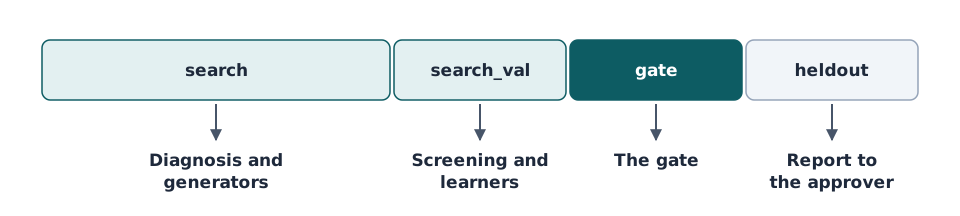
rsi_splits(n_states, (a, b, c)) is the RFC-0002 partition that improvement campaigns need: search (0..a-1, for
diagnosis and learning), search_val (a..b-1, selection), gate (b..c-1, the paired test) and heldout
(c..n-1, reported only). replicates adds noise replicates of every init state, and gate_looks > 1 adds
gate_r1, gate_r2, ... for the sequential gate. See splits.
How the references do it:
Two tasks, a fixed target (params: {target: [0.35, 0.2]}) and a random one, 150 steps each.
mujoco_benchmark(protocol=...) offers standard splits (train / validation / heldout) and rsi splits over
rsi_states seeds (40 / 20 / 20 / 20 percent), offset by 30000 so they never overlap the standard ones.
Ten tasks per suite, read from a task index. Init states are stored: init=InitStateRef(uri="libero://libero_10/<task>",
count=50), and seed s loads state s % 50. Success is LIBERO's BDDL goal (Predicate(kind="expr",
name="bddl_goal", expr=...)), evaluated inside the environment. protocol: rsi with
rsi_bounds: [20, 30, 40] gives the RFC-0002 splits over the 50 states.
4. Register it
Environments and benchmarks are found by name through entry points; declare the contract versions too:
[project]
name = "hylo-env-slider"
dependencies = ["hylo-core", "hylo-eval", "numpy>=1.24"]
license = "Apache-2.0"

[project.entry-points."hylo.envs"]
"slider" = "hylo_env_slider.env:SliderEnv"

[project.entry-points."hylo.benchmarks"]
"slider-v0" = "hylo_env_slider.env:slider_benchmark"

[project.entry-points."hylo.meta"]
"hylo-env-slider" = "hylo_env_slider:META"
META = {"contracts": {"envs": "hylo.env/v0.1", "benchmarks": "hylo.benchmark/v0.1"}, "maturity": "unverified"}
hylo-env-mujoco registers mujoco.planar_reach, mujoco.table_reach, mujoco/reach-v0 and mujoco/table-v0
exactly this way. Before installing, use module:attr names in configs (below, with the package on PYTHONPATH).
There is no hylo plugin new env template; copy this page's file or hylo-env-mujoco's.
5. Check conformance
A config with the environment and a simple agent. Any policy that reads pos and goal will do; this one is a
proportional controller written as a ChunkPolicy in the same file:
schema_version: hylo.experiment/v0.1
name: slider-p
benchmark: {type: "hylo_env_slider.env:slider_benchmark", split: search_val}
env: {type: "hylo_env_slider.env:SliderEnv"}
agent: {type: policy, params: {policy: {type: "hylo_env_slider.env:SliderPolicy"}}}
output_dir: runs
environment SliderEnv: PASS
  [  ok] spec() is cheap and typed: 0.1 ms
  [  ok] spec survives JSON (wire format)
  [  ok] reset returns an Observation matching the spec: instruction='stop on the goal'
  [  ok] reset is deterministic in the seed
  [  ok] step returns StepResult with separate success/terminated/truncated: 5 steps
  [skip] snapshot/restore reproduces the trajectory
  [  ok] close() works
agent PolicyAgent: PASS
  [  ok] spec is compatible with the environment: slider.p
  [  ok] act returns finite chunks of the env's action shape
  [  ok] reset leaves no state behind (same seed, same episode)
The snapshot check is skipped because the environment does not declare snapshot; MuJoCo planar reach passes it.
--nondeterministic skips the same-seed check for simulators that cannot be made deterministic, and
--spec-budget allows a slower spec() for remote environments. The first error here costs seconds; the same
error in a 500-episode run costs an afternoon.
6. Run it
{
  "run_dir": "runs/slider-p-search_val-136ee3ee3eb1807b-3941c1",
  "config_digest": "136ee3ee3eb1807b",
  "success_mean": 1.0,
  "safety_interventions_mean": 0.0,
  "steps_mean": 10.2,
  "n_episodes": 10,
  "n_scored": 10
}
Every step is in the run's trace: observation, the agent's agent.chunk, the safety.review (proposed and
approved action), the action actually sent, step.result, and episode.start / episode.end
(experiments).
7. Out of process, in its own venv
A simulator with conflicting dependencies (LIBERO needs robosuite 1.4 and its own numpy) runs in a subprocess started from another interpreter. Nothing in the environment changes; the config says where it runs:
env:
  type: libero
  remote: {runtime: libero-sim}          # interpreter and env vars from this machine's profile
remote: {} uses the current interpreter. The slider run with --set 'env.remote={}' gives the same
results and the same config_digest (136ee3ee3eb1807b): where a component runs is never part of what is
measured. Register the runtime once per machine:
Install hylo-core and your package into that venv. bench's envs/libero/setup.sh does exactly this for LIBERO
(profiles).
Each connection gets its own environment instance, so parallel workers become parallel connections. Use
--token-env for a shared token and an SSH tunnel or wss:// across untrusted networks.
A WebSocket environment changes the digest
The remote.ws form names the transport and its URL as the environment, so its runs have a different
config_digest from the local or subprocess form (761f19c6d3e1b367 for the slider instead of
136ee3ee3eb1807b). Use remote: {runtime: ...} when results must compare by digest.
8. Actions and safety
The SafetyShield checks every action against the environment's declared action box before it reaches step():
non-finite actions are refused, and values outside the bounds are clipped (a clip within clip_tolerance, default
0.05, is bookkeeping; a larger one counts as an intervention). An environment can contribute an always-on workspace
guard through EnvSpec.workspace (WorkspaceLimit(state_key, low, high, action_dims)): delta motions that would push
the controlled point further outside the box are zeroed. Experiments add guards with safety: (max_delta, or
guards: [{type: keep_out, params: {...}}]). See safety.
Declare max_step in the action semantics: it is what the units mean at |action| = 1, and it is how a policy
trained on one environment can be checked against another.
9. A protocol in bench
To make the environment a benchmark others can score against, write a protocol: it fixes the benchmark, the split that is scored, the environment, the trace options and the timing, and its digest covers exactly what is measured (protocols).
schema_version: hylo.protocol/v0.1
name: slider-reach
version: "1"
description: |
  The slider stops on its goal: the 10 held-out init states of the RFC-0002 split (40-49).
benchmark: {type: "hylo_env_slider.env:slider_benchmark", split: heldout, params: {protocol: rsi}}
env: {type: "hylo_env_slider.env:SliderEnv"}
trace: {record_privileged: false, image_every: 0}
workers: 4
requires: [hylo-env-slider]
uv run hylo bench show slider-v1.yaml          # digest: 13026fb9ab2bee26
uv run hylo bench run slider-v1.yaml --name p-0.5 \
    --policy '{"type": "policy", "params": {"policy": {"type": "hylo_env_slider.env:SliderPolicy"}}}'
Ten episodes give a wide interval; the built-in protocols use 100 (MuJoCo reach) and 500 (LIBERO-10). A protocol
that ships with hylo-bench goes in packages/hylo-bench/src/hylo/bench/protocols/.
10. A robot
A real robot is an environment like any other; hylo-env-lerobot-robot (lerobot.robot) wraps LeRobot's Robot
interface (SO-100/101, Koch, LeKiwi, ROS 2 robots through LeRobot plugins, and sim_arm for bring-up without
hardware). What it adds to the contract:
real_robot=True: any SafetyShield modification aborts the episode, and clipping has no tolerance;- an action box with explicit limits (
action_low,action_high) in the robot's units andjoint_possemantics; reset: connect, move tohomeby interpolation inhome_stepssmall steps within the shield's limits; the scene is the operator's job, and the workcell waits for the operator's "reset done";successis alwaysNone: the operator's verdict or a calibrated judge labels the episode (unlabeleduntil then);hold_action(last): the measured position, executed when the policy is late;stop(): hold now (the e-stop path, in addition to the robot's hardware e-stop).
The kernel uses hold_action and stop when an environment provides them; without them, it holds delta and
velocity control at zero motion and refuses to guess a hold for absolute control.
A robot runs in a workcell (hylo-serve), not in an experiment: the workcell config adds the policy endpoint, the realtime runner settings, safety limits and where runs are recorded:
name: sim-arm
env:
  type: lerobot.robot
  params:
    robot: {type: sim_arm, params: {image_size: 128, max_relative_target: 10}}
    cameras: {front: agentview}
    action_low: [-120, -120, -120, -120, -170, 0]
    action_high: [120, 120, 120, 120, 170, 100]
    home: [0, -30, 60, 0, 0, 20]
    control_hz: 30
policy: {url: "ws://127.0.0.1:8002/hylo", protocol: hylo}
runtime: {clock: wall, refill_steps: 5, max_hold_steps: 60, require_reset_confirm: true, verdict_timeout_s: 120}
safety: {max_delta: 12.0}
image_every: 5
max_steps: 300
output_dir: runs/workcell
lerobot.robot is listed as needs-hardware in the plugin catalogue: it has run with the
simulated arm only. See deployment and
the deployments repository.
Next
- Score policies on it: benchmarking, adding a policy.
- Improve a policy on it with a campaign: campaigns.
- API: hylo-env-mujoco, hylo-env-libero,
hylo-eval; commands:
hylo conformance,hylo serve,hylo bench.