Deployment
hylo-serve runs policies next to robots. Two services split the work:
- a policy server (
hylo serve policy) runs an agent, usually on a GPU machine, and answers observations with action chunks; - a workcell (
hylo serve workcell) runs next to the robot or simulator. It owns the environment, the SafetyShield, the episode loop and the trace, and reaches the policy over the network.
Safety never depends on the network: if the policy server is slow the arm holds, if it stops answering the watchdog aborts the episode, and an e-stop is latched in the workcell until an operator clears it. The playground in studio is the control plane: it starts episodes and relays operator input, but never sends actions.
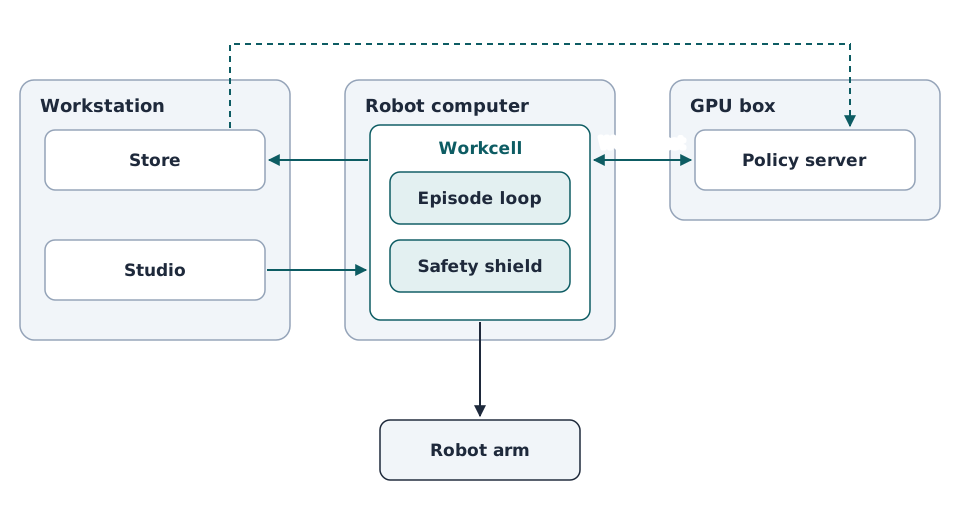
Who talks to whom: the control plane calls the workcell API; the workcell calls the policy server; episodes are recorded where the robot is and copied to the workstation through the store.
serve's packages depend on hylo-core only, so a robot computer installs nothing else.
Policy server
uv run hylo serve policy --agent '{"type": "bringup.wave", "params": {"amplitude": 12, "horizon": 15}}' --port 8002
uv run hylo serve policy --config bench/examples/configs/libero10_steered.yaml --port 8001   # the config's agent
uv run hylo serve policy --campaign runs/evolve/libero10-steering --port 8001               # a campaign's active version
| Option | Default | Meaning |
|---|---|---|
--agent JSON / --config FILE / --campaign DIR |
(one required) | what to serve: an agent spec, an experiment config's agent, or a campaign's active version |
--host |
127.0.0.1 |
bind address; 0.0.0.0 exposes it on the network |
--port |
8000 |
|
--token |
none | require Authorization: Bearer <token> (or openpi's Api-Key <token>) |
--openpi-inputs |
libero |
preset name, or a JSON mapping from openpi observation keys to observation fields |
One WebSocket server speaks two protocols, chosen by path:
| Path | Protocol | Clients |
|---|---|---|
/hylo |
the Hylo agent protocol (JSON): spec, reset, act, on_step, on_episode_end | workcells, remote.ws agents |
/openpi |
openpi's protocol (msgpack-numpy): metadata, then observation dict in, {"actions": (H, A)} out |
openpi clients (DROID, RoboArena, openpi's examples) |
/healthz, /meta |
HTTP | liveness; the served agent's spec as JSON |
resetcarries the client's EnvSpec. The server refuses the session there, before any motion, if the agent is not compatible with it (core.compat: action space, control mode, cameras, state keys).- One session at a time: a robot talks to one policy, and a second client is refused (close code 1013). The agent is built once and reused across sessions.
- With
--campaign, the server follows the campaign'sactive.json(hylo.active/v0.1, campaigns): when a promotion or a rollback changes the active version, it rebuilds the agent between sessions, never during one. - openpi has no reset message: the agent is reset on connect, when the prompt changes, or when the client sends
{"reset": true}.
Workcells
uv run hylo serve workcell --config deployments-template/workcells/sim_arm.yaml --port 8102
uv run hylo serve workcell --config workcells/so101.yaml --host 0.0.0.0 --port 8100 --token $HYLO_TOKEN
--config (required), --host (default 127.0.0.1), --port (default 8100), --token. A workcell config
(hylo.serve.workcell.WorkcellConfig) lives in your lab's deployments repository:
name: sim-libero10
env:
  type: libero
  remote: {runtime: libero-sim}          # the simulator in its own venv (execution profile)
benchmark:                               # optional: named tasks and init states
  type: libero
  params: {suite: libero_10, n_validation: 10, n_heldout: 0}
policy: {url: ws://127.0.0.1:8001/hylo, protocol: hylo}
runtime: {clock: virtual, refill_steps: 10, max_hold_steps: 200}
image_every: 10
split: deployment
output_dir: runs/workcell
| Field | Default | Meaning |
|---|---|---|
name |
(required) | the workcell's name; its run is <output_dir>/workcell-<name> |
env |
(required) | any environment plugin, local or in another venv (remote) |
benchmark |
none | a benchmark whose tasks can be started by task_id; without it, free-form instructions only |
policy |
none | default policy endpoint: url, protocol (hylo or openpi), token, params |
runtime |
realtime, wall clock | the episode loop's timing (below), plus image_every and record_privileged |
safety |
{} |
SafetyShield config: max_delta, guards (safety) |
image_every |
10 |
keep every n-th frame in the trace (every frame is streamed live) |
split |
deployment |
the split recorded episodes get; no learner reads it unless asked |
max_steps |
600 |
step limit for free-form instructions (benchmark tasks have their own) |
output_dir |
runs/workcell |
where the run is written, relative to the working directory |
The realtime runner
The workcell runs the same episode loop as evaluation: core.kernel.EpisodeRunner, in realtime mode
(RFC-0005 part 3). A benchmark can therefore measure
exactly what a workcell runs (timing: {mode: realtime} in an experiment or protocol).
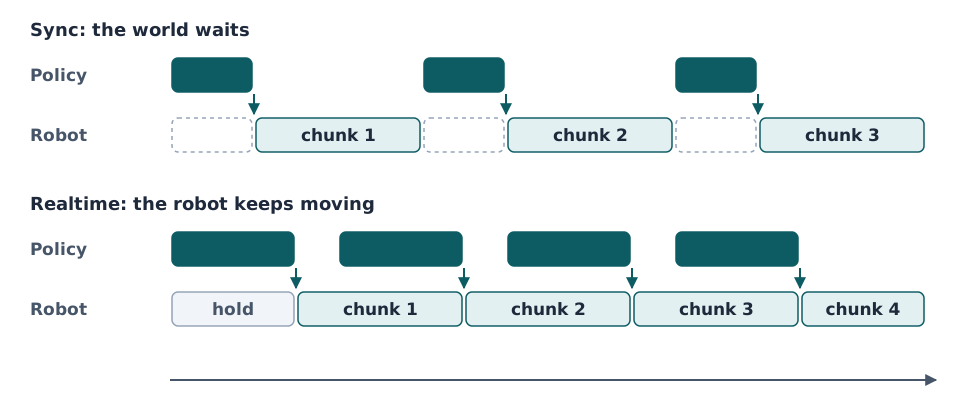
Sync: the world waits for every policy call. Realtime: the next chunk is requested while the current one still executes; actions that went stale during inference are dropped, and gaps are held.
In realtime mode:
- when only
refill_stepsactions are left in the queue (or earlier, withadaptive_refill, when the queue covers only the recent latency plus one step) the runner requests the next chunk; - when the chunk arrives it is merged aligned with time: the actions for steps that already passed during inference are dropped;
- when the queue is empty the arm executes a hold action: the environment's own
hold_action(a real robot holds its measured position), the last target for absolute control, or zero motion with the gripper kept for delta control; - after
max_hold_stepsconsecutive holds the watchdog aborts the episode.
runtime field |
Default | Meaning |
|---|---|---|
mode |
realtime (in a workcell) |
sync waits for every call |
clock |
virtual |
virtual: simulated latency, deterministic; wall: a real control loop at control_hz, the policy in a worker thread. Use wall on hardware |
control_hz |
the environment's | control rate |
refill_steps |
2 |
request the next chunk when this many queued actions remain |
adaptive_refill |
true |
request earlier when the recent latency needs it |
latency_s |
measured | virtual clock only: a fixed inference latency instead of the measured one |
max_hold_steps |
100 |
watchdog |
require_reset_confirm |
false |
wait for the operator's reset_done before an episode starts |
verdict_timeout_s |
0 |
how long to wait for the operator's verdict when the environment cannot judge success |
image_every, record_privileged |
1, true |
what the trace keeps |
Operating a workcell
The workcell API (hylo.workcell/v0.1, models in hylo.core.remote.workcell, so the control plane never
imports serve):
| Endpoint | Body / reply | Notes |
|---|---|---|
GET /healthz |
{"ok": "yes"} |
no auth |
GET /status |
name, state, episode, last result, latched fault, run id, policy, split, runtime, tasks | |
POST /episodes |
StartEpisode → EpisodeStarted |
409 while an episode runs or a fault is latched |
POST /operator |
OperatorEvent → OperatorAck |
400 for an unknown or malformed event |
WS /events |
one JSON event per message | observations (JPEG), actions, chunks, safety, operator events, done |
With --token, HTTP calls need Authorization: Bearer <token> and the WebSocket ?token=<token>.
A StartEpisode names a task_id of the workcell's benchmark (with seed), or a free-form instruction; with a
task_id, an instruction overrides only what the agent hears, not the task or its success check. policy
overrides the configured endpoint. States: idle, starting, running, awaiting_reset, awaiting_verdict,
fault.
curl -s -X POST localhost:8102/episodes -H 'content-type: application/json' -d '{"instruction": "wave", "max_steps": 120}'
curl -s -X POST localhost:8102/operator -H 'content-type: application/json' -d '{"type": "reset_done", "by": "me"}'
curl -s -X POST localhost:8102/operator -H 'content-type: application/json' -d '{"type": "verdict", "verdict": "success"}'
Operator events:
| Event | Effect |
|---|---|
stop |
end the episode (the robot holds) |
estop |
stop and latch a fault: no episode starts until clear_fault |
clear_fault |
clear the latched fault |
reset_done |
the scene is reset; the episode may start (require_reset_confirm) |
verdict |
success, failure or partial for an episode the environment could not judge |
The playground's operator station sends these with roles (studio); the e-stop is open to every role.
Not a certified safety function
The SafetyShield is a software layer. On a real robot keep the robot's own limits (LeRobot's
max_relative_target, torque limits) and a hardware e-stop within reach. For real_robot environments the
shield aborts on any modification instead of correcting the action (safety).
Robots and bring-up
hylo-env-lerobot-robot (lerobot.robot) turns any robot with LeRobot's Robot interface into an environment:
SO-100/101 and Koch followers and others. It adds an EnvSpec (named state groups, cameras, an action box in the
robot's units, the control rate), resets by moving to the home pose in small steps within the shield's limits,
never claims success (the operator's verdict or a calibrated judge decides), and holds the measured position when
the policy is late.
Bring a workcell up without hardware first:
uv run hylo serve policy --agent '{"type": "bringup.wave", "params": {"amplitude": 8}}' --port 8002
uv run hylo serve workcell --config deployments-template/workcells/sim_arm.yaml --port 8102
sim_arm is a simulated five-joint arm with a gripper, in degrees like LeRobot's SO follower, with first-order
motor dynamics and a per-step limit on the commanded change. bringup.wave makes small sinusoidal moves around the
measured pose, joint by joint: it checks the chain (policy server, workcell, adapter, motors) without coming near
any limit. Then the same with the real arm (workcells/so101.yaml, with lerobot[feetech] in the robot venv).
Maturity
lerobot.robot has run with the simulated arm only; no real arm has been connected yet
(plugin catalogue).
Recorded episodes
Every workcell episode is recorded as an ordinary run in <output_dir>/workcell-<name>/: a trace per episode,
evallog.json and manifest.json updated after each one. Replay, judges and the catalog work on it. The operator's
verdict is the episode's label (labels.success.by: operator:<who>).
To bring the runs to the workstation, make the workcell's output directory the robot computer's store and pull from it:
hylo store init runs                                         # on the robot computer, where output_dir lands
uv run hylo store pull robot-host:/path/to/runs              # on the workstation: runs it does not have yet
uv run hylo store push robot-host:/path/to/runs artifact:l10-trace-v2@54a1efadf00d34d8   # an artifact the other way
Serving one component
hylo serve env and hylo serve agent put a single plugin behind a WebSocket (core.remote.ws), for example a
simulator in its own venv on another machine:
uv run hylo serve env libero --params '{"image_size": 256}' --port 8765
uv run hylo serve agent lerobot --params '{...}' --port 8766 --token-env HYLO_TOKEN
Configs then use {type: remote.ws, params: {url: "ws://host:8765"}} as the environment or agent.
--token-env names an environment variable holding the token, so it never appears in a command line.