Architecture overview
Hylo evaluates robot policies, learns from what they did, improves them under a statistical gate and deploys them to robots, behind one set of contracts. This page is the map: the layers, the one episode loop, how data flows from runs to deployed versions, and the decisions behind them. The full design is in architecture; the decisions are recorded in the RFCs.
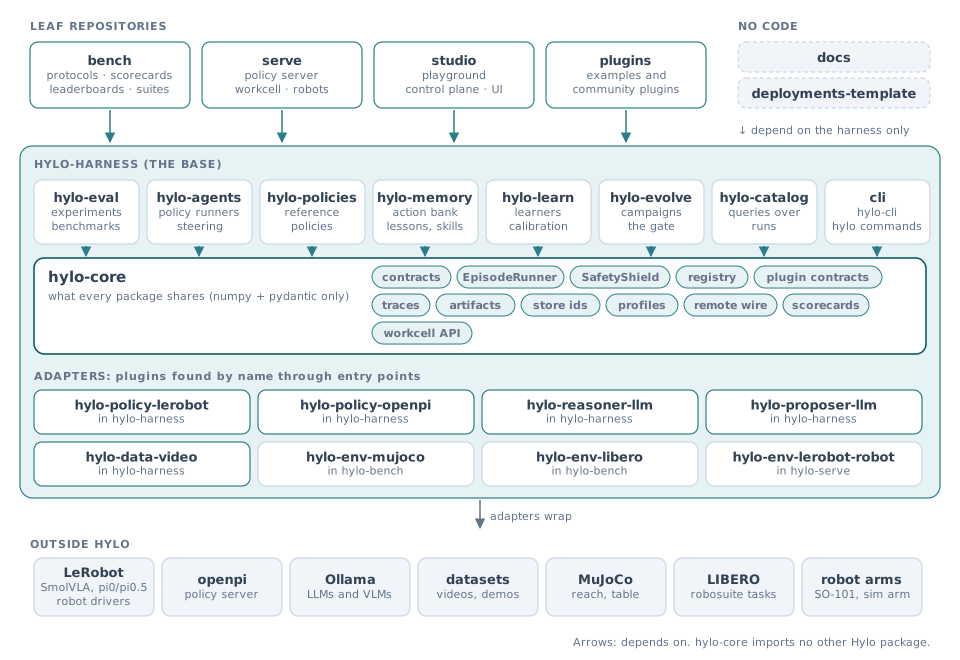
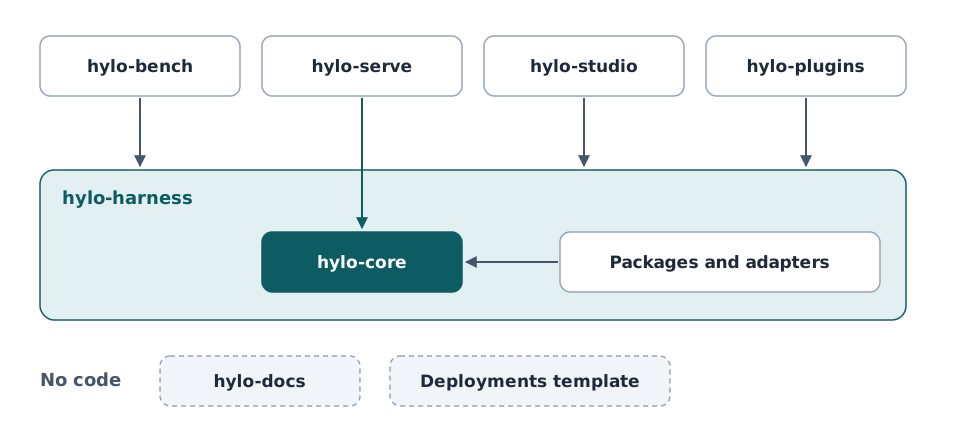
The harness is the base: hylo-core defines the contracts and runs every episode; the other harness packages build on it; bench, serve, studio and plugins are leaves that use it.
Layers
| Layer | Packages | Role |
|---|---|---|
| Contracts and kernel | hylo-core |
data contracts (EnvSpec, Observation, ActionChunk, TaskSpec, ...), behavioural contracts (Environment, Agent, ChunkPolicy, Guard, Learner, ...), the episode loop, the SafetyShield, events and traces, the plugin registry, experiment configs, store, formats |
| Evaluation | hylo-eval |
benchmarks and splits, the runner, scorers, paired statistics and gate tests |
| Decision-making | hylo-agents, hylo-policies, hylo-memory |
agents that run any policy (plain, temporal ensemble, steered), reference policies, memories, reasoners, instruments |
| Learning | hylo-learn |
learner jobs, sealed artifacts, judge calibration and labelling, external data |
| Improvement | hylo-evolve |
campaigns: generators, the cascade, the sequential gate, approvals, active versions |
| Catalog and CLI | hylo-catalog, hylo-cli |
read-only queries over runs and campaigns; the harness's hylo commands |
| Adapters | hylo-policy-lerobot, hylo-policy-openpi, hylo-reasoner-llm, hylo-proposer-llm, hylo-data-video |
third-party stacks behind the contracts |
| Leaves | bench, serve, studio, plugins | benchmarking, deployment, the playground, example plugins |
Three rules hold the layers together:
- The kernel only knows contracts. It runs an
Agentagainst anEnvironment; reasoners, policies, memories and world models are inside agents. Any simulator, robot or policy stack plugs in as a plugin. - Every action passes the SafetyShield. Agents never construct it and campaigns cannot change its config.
- Scoring reads traces only. A scorer sees what happened, never the agent's internals.
One episode loop
core.kernel.EpisodeRunner runs every episode: in evaluation, in the playground's live sandbox and in a workcell
next to a robot (RFC-0005 part 3). Its timing is
part of what an experiment measures:
- sync: the world waits for every policy call; a chunk executes
execution_stepsactions; - realtime: the next chunk is requested while the current one executes; actions that went stale during inference are dropped, gaps are held, a watchdog aborts after too many holds; on a virtual clock (deterministic, for benchmarks) or the wall clock (a real control loop).
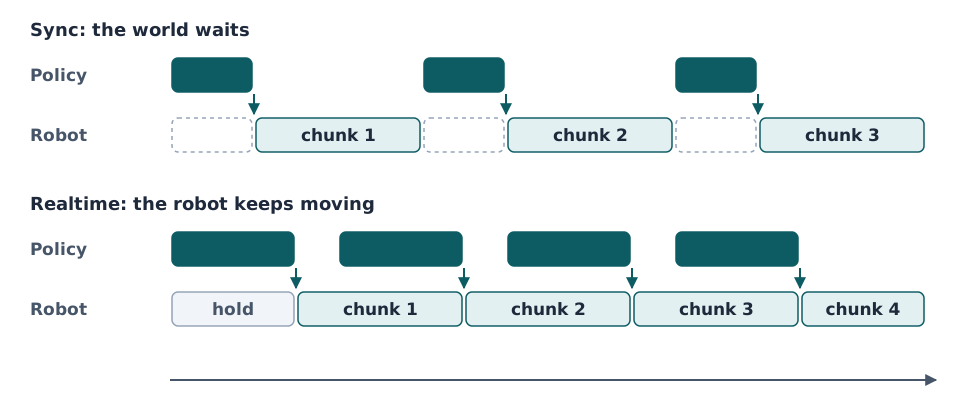
The same loop in both modes. A benchmark in realtime timing measures what a robot will run: on LIBERO-10 the first reading was 0.20 success in sync and 0.05 in realtime for the same policy and episodes (20 episodes; not yet conclusive).
Every step emits events (observation, agent chunk, safety review, action, step result) to an event bus; a trace
store writes them per episode, with images every image_every steps and privileged simulator state when asked.
Replay, scoring, judges, learners and the catalog all read these traces.
From runs to deployed versions
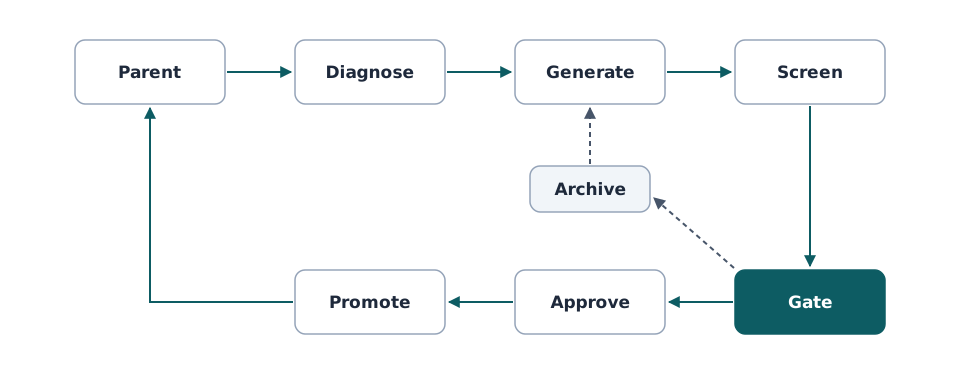
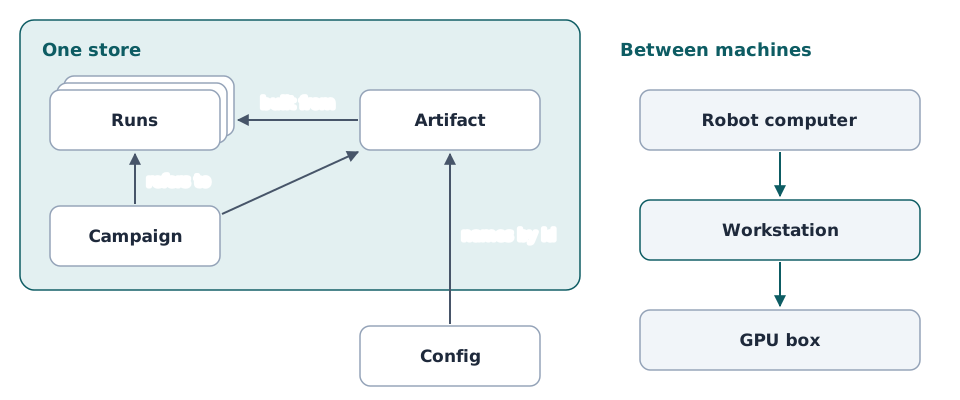
- Runs. An experiment (config) runs a benchmark split and records traces and an
evallog.json. A protocol fixes everything but the policy and writes a scorecard. - Artifacts. Learners build artifacts from runs: action memories, critics, judges, world models, policy weights (learning, RFC-0004). Each is sealed with a content digest and its provenance, and has one of three roles: behaviour (changes what the robot does; only the gate activates it), instrument (measures; trusted only after calibration), proposal (changes what gets proposed).
- Candidates. Generators propose candidates as config patches (a steering rule, a learned critic, new weights), each with a hypothesis.
- The gate. A campaign screens candidates on development splits and tests the survivors on a gate split with a group-sequential paired test, regression and safety vetoes; the held-out split is reported, never used to decide (campaigns, RFC-0002).
- Promotion. A candidate that passes becomes the campaign's active version (
active.json), which a policy server can follow. Withapproval: manual(the setting for anything that runs on hardware; the default isauto) it first waits for a person's approval. Rollback is one command. - Deployment. A workcell runs the active version on the robot through the same loop; its episodes are recorded as runs and flow back through the store (deployment).
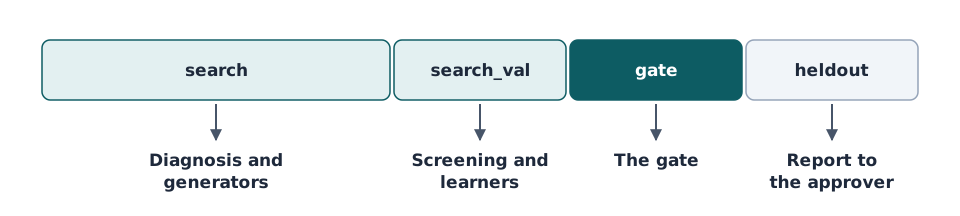
The split guard: learners and generators read development splits only; the gate decides on its own split; held-out data is never read by anything that is gated on it. Builders refuse forbidden splits, and the gate re-checks the provenance of every artifact a candidate references.
Measurement vs placement
An experiment's identity is what it measures: benchmark and split, environment, agent, safety, trace, timing. Where components run is not part of it (RFC-0005 part 1):
- configs name runtimes (
remote: {runtime: libero-sim}), resolved by each machine's execution profile; - configs name artifacts by store id (
artifact:l10-trace-v2@54a1efadf00d34d8), resolved to a path on the machine that builds the component (store); - the digest is taken over the ids and names, so the same experiment has the same digest on the workstation, the GPU machine and the robot computer.
Repositories
| Repository | Holds | Depends on |
|---|---|---|
| hylo-harness | the layers above, the hylo dispatcher, the reference docs |
- |
| hylo-bench | protocols, scorecards, leaderboards, LIBERO and MuJoCo suites and their setup | harness |
| hylo-serve | policy server, workcell, robot adapters | hylo-core only |
| hylo-studio | the playground and control plane | harness |
| hylo-plugins | example plugins written as a third party would | harness |
| hylo-docs | this site, RFCs, research | - |
<lab>-deployments |
a lab's workcell configs and safety limits | (configuration only) |
Leaves never import each other: they cooperate through formats in hylo-core (formats): traces,
artifact manifests, store ids, scorecards, active.json, the workcell API. A boundary lint enforces the rules
(contributing, repository structure).
Key decisions
| Decision | Why | Where |
|---|---|---|
| A light core with protocols and plugins; heavy stacks out of process | no simulator, LLM or VLA is mandatory; components with conflicting dependencies run in their own venvs | RFC-0001 |
| Improvement is a gated experiment, frozen policy first | a change is kept only if a paired test on unseen init states says so; weights change only once the loop is trustworthy | RFC-0002 |
| Experience as memory and skills, not only weights | retrieved successes, lessons and skills steer a frozen policy and are cheap to roll back | RFC-0003 |
| Everything learned is a sealed artifact with a role | behaviour, instrument and proposal artifacts get different trust paths; the split guard is checked twice | RFC-0004 |
| Measurement separated from placement; one episode loop; store ids; versioned contracts | results transfer between machines and from simulation to the robot | RFC-0005 |
| One base repository and leaves | atomic changes in the base, independent leaves, a robot installs only hylo-core | repository structure |
Not yet
- No job layer: campaigns run in a foreground process, studio jobs are bare subprocesses (RFC-0005 part 6).
- Every plugin contract is in hylo-core, one group per role; the hylo-agents package itself still holds decision-making agents, instruments and rule-based reasoners together (RFC-0005 part 5).
- No real robot has been connected; the robot path has run with a simulated arm.
- Weight-level learning on LIBERO (self-training, RL fine-tuning) waits for a GPU.