Adding a learner
This tutorial covers the four ways to make Hylo learn, from a plugin package to a gated, promoted result:
| You want to | Write | Contract | Reference implementations |
|---|---|---|---|
| build a model from recorded runs | an offline learner | Learner.fit(job) -> sealed artifact |
policy.bc / flow / knn / tokens (hylo-policies), critic.chunk_value, world_model.state, judge.trace (hylo-learn) |
| learn by acting | an online learner | OnlineLearner: start / policies / update / finished / seal |
examples.cem (hylo-plugins) |
| measure or label episodes | an instrument (success judge) | SuccessJudge.judge(trace) -> Judgement |
judge.trace (hylo-agents), judge.vlm |
| propose improvements | a candidate generator | propose(diagnosis, cfg, parent_id, archive) -> [(Candidate, hypothesis)] |
rule.gain, rule.steering, learn (hylo-evolve), llm.steering |
The steps were run while writing this page, in a scratch directory with its own store; the outputs are real. The background is in learning and campaigns.
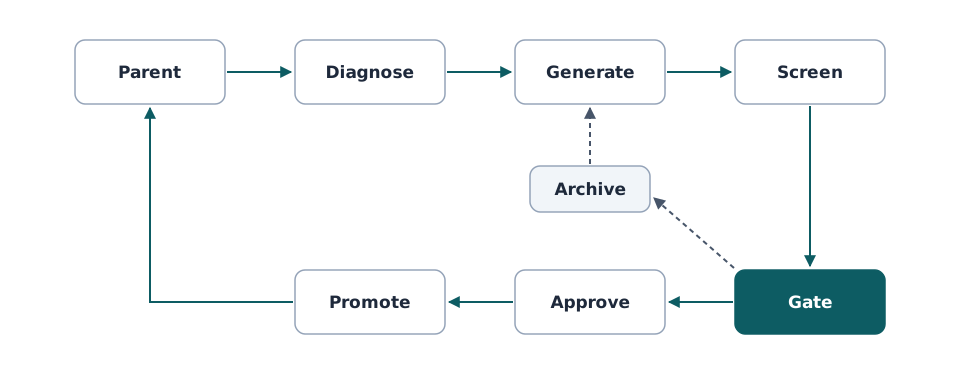
The rules every learner follows
- Development data only. A learner reads runs of the
searchandsearch_valsplits, nevergateorheldout.development_runs(job.inputs, job.splits)finds the runs and skips the others;check_splitsrefuses a job that asks for gate or held-out data;write_manifestrefuses to seal an artifact whose sources include such a run; the gate checks the provenance a third time. See the split guard. - One sealed directory out. The learner writes its files into
job.outand callswrite_manifestlast. The manifest records the kind, the role, a content digest over every file, the builder, and every source run. Changing a file afterwards makes the artifact fail verification. - A role decides who may trust it.
behaviourartifacts change what the robot does (policies, critics, memories) and only the gate activates them;instrumentartifacts measure (judges, world models) and are trusted only after calibration;proposalartifacts only change what gets proposed;datais ingested data. - Jobs are resumable. A
TrainJob's digest covers everything butout. Whenoutalready holds a sealed artifact with the same job digest, the job is not run again.
1. An offline learner
The generated learner summarises the success rate of development runs into one sealed file. Replace the middle with your model:
class MyRecapLearner:
    name = "my-recap@0.1"

    def fit(self, job) -> ArtifactManifest:
        sources = development_runs(job.inputs, job.splits)           # gate / held-out are refused or skipped
        episodes = [s for rd, _ in sources for s in json.loads((rd / "evallog.json").read_text())["samples"]]
        out = Path(job.out)
        out.mkdir(parents=True, exist_ok=True)
        rate = sum(s["status"] == "success" for s in episodes) / max(1, len(episodes))
        (out / "model.json").write_text(json.dumps({"success_rate": rate}))   # your model here
        return write_manifest(out, kind="other", role="behaviour", metrics={"episodes": len(episodes), "success_rate": rate},
                              provenance=Provenance(builder=self.name, sources=[r for _, r in sources], params=dict(job.params)))
development_runs returns (run_dir, SourceRef) pairs. Read episodes from each run's evallog.json and their
step-by-step events with core.trace.TraceStore(run_dir).read(episode_id); hylo.policies.reference.base.load_demos
shows how the reference policies turn traces into (observation, next T actions) pairs.
kind is one of dataset, action_memory, value_model, noise_policy, policy_weights, policy_params,
success_judge, progress_model, world_model, lesson_book, skill_library, other.
Register it (the template does) and check it:
[project.entry-points."hylo.learners"]
"my-recap" = "hylo_my_recap.plugin:MyRecapLearner"
learner hylo_my_recap.plugin:MyRecapLearner: PASS
  [  ok] runs and seals a verifiable artifact: other / behaviour, digest 740f272a4d5caa2c
  [  ok] provenance lists development data only: splits ['search', 'search_val']
  [  ok] refuses gate / held-out splits
  [  ok] an identical job reuses the artifact
Run a job
A job names the learner, the runs to read (directories, roots to search, or store ids such as run:<id>), where to
seal, the splits (default search, search_val) and the learner's parameters:
uv run hylo learn recap.json                                       # in this process
uv run hylo learn recap.json --python /path/to/other/venv/bin/python   # with another venv's interpreter
{"out": "runs/artifacts/recap", "kind": "other", "role": "behaviour", "digest": "740f272a4d5caa2c",
 "splits": ["search"], "metrics": {"episodes": 80, "success_rate": 1.0}}
A job that asks for gate data is refused before anything is read:
{"learner": "my-recap", "inputs": ["runs/demos"], "out": "runs/artifacts/x", "splits": ["search", "gate"]}
hylo.core.artifact.SplitLeak: gate / heldout data must never be used to build anything that is gated on it: ['gate']
Then reference the artifact by its store id (uv run hylo store ref runs/artifacts/recap) in the component that
loads it, as in adding a policy.
Learners with heavy dependencies
A learner that needs torch (the LeRobot ones) runs in that venv: hylo learn job.json --python ..., or python:
/ python_path: in the learn generator below. hylo-learn is light (hylo-core and hylo-agents), so install it into
the model's venv.
2. An online learner
An online learner learns by acting. Each iteration it proposes agent specs; the runner evaluates each on a
development split (ordinary runs, recorded under <out>/rollouts/iter-NNN/); the learner updates from the results;
at the end it seals an artifact whose provenance lists every rollout run.
class OnlineLearner(Protocol):
    name: str
    def start(self, job: TrainJob, agent: dict[str, Any]) -> None: ...          # the base agent spec
    def policies(self) -> list[dict[str, Any]]: ...                              # agent specs for this iteration
    def update(self, results: list[dict[str, Any]]) -> dict[str, Any]: ...      # one per policy: agent, run_dir, metrics, samples
    def finished(self) -> bool: ...
    def seal(self, out: str, sources: list[Any]) -> ArtifactManifest: ...
The job carries the experiment to roll out in as params.experiment, plus iterations (default 3) and split
(default the job's first split, search). examples.cem (hylo-plugins, hylo_examples/online.py) is the
cross-entropy method over numeric agent parameters: policies() samples a population from a Gaussian, update()
scores each rollout by success_mean - step_penalty * mean steps and refits the Gaussian to the elites, seal()
writes best.json. The same contract fits on-policy RL: policies() returns the current policy, update() reads the
rollouts' traces from run_dir and takes a gradient step, seal() writes the weights.
hylo plugin new online_learner NAME scaffolds one (random search over one parameter), and hylo plugin check
online_learner NAME checks it. Online learners are usually run by the learn generator, below.
3. A success judge (instrument)
A success judge labels episodes the simulator cannot label: robot episodes, external videos. It reads only what a
real robot records (observations and actions, no privileged state) and returns Judgement(p_success, progress, info):
hylo plugin new judge NAME scaffolds one; hylo plugin check judge NAME checks it. A judge that is learned has a
learner too: judge.trace (hylo-learn) trains a classifier on the last frames of development episodes, labelled with
the simulator outcome, and seals a success_judge artifact with role instrument.
An instrument is trusted only after calibration against ground truth, on runs it was not built from:
uv run hylo calibrate --judge '{"type": "judge.trace", "params": {"path": "artifact:l10-trace-v2@54a1efad"}}' \
    --runs runs/... --artifact artifact:l10-trace-v2@54a1efad --target-precision 0.95 --out calibration.json
The report gives AUC, Brier score, calibration error, and the lowest threshold that reaches the target precision.
It is ready when it has at least 50 episodes, reaches the target precision, and keeps a recall of at least 0.3.
--artifact excludes the judge's own training runs and stores the report in the artifact. Only a ready judge may
label (hylo label RUN --judge ID), and only at or above its calibrated threshold; episodes below it stay
unlabeled. The LIBERO-10 trace judge reached AUC 0.92 on 600 episodes
(experiment record).
4. A candidate generator
A generator proposes improvements to a campaign's current best configuration (the parent). It gets the parent's
diagnosis on the search split and returns candidates, each a config patch with a hypothesis:
class Proposer(Protocol):
    name: str
    def propose(self, diagnosis: Mapping[str, Any], cfg: ExperimentConfig, parent_id: str | None,
                archive: list[ArchiveEntry]) -> list[tuple[Candidate, str]]: ...   # (candidate, hypothesis)
diagnosisholdsn_episodes,n_failures,success, failurebucketsandbucket_rate,per_task, example episode ids and the parent'srun_dir(so a generator can read the traces).cfgis the parent's experiment config;archiveis every candidate tried so far, with its stages and verdict.- A
Candidateispatch(dotted config paths to new values),rationale,parent_id,generator, andevidence.
The scaffold scales one numeric path, like the built-in rule.gain:
class MyGainProposer:
    name = "my-gain@0.1"

    def __init__(self, path: str = "agent.params.kp", factors: tuple[float, ...] = (1.5,)) -> None:
        self.path, self.factors = path, factors

    def propose(self, diagnosis, cfg, parent_id, archive):
        node = cfg.model_dump(mode="json")
        for k in self.path.split("."):
            node = node[k]
        return [(Candidate(patch={self.path: float(node) * f}, rationale=f"scale by {f}", parent_id=parent_id,
                           generator=self.name), f"scaling {self.path} by {f} reduces the failures in the diagnosis")
                for f in self.factors]
generator my-gain@0.1: PASS
  [  ok] proposes (Candidate, hypothesis) pairs: 1 candidates
  [  ok] candidates stay outside protected scopes and apply to the config
  [  ok] candidates name their generator
Register it under hylo.generators and use it in a campaign as proposer: {type: my-gain, params: {...}}.
What a candidate must pass before it costs an evaluation
Stage 0 of the cascade rejects a candidate without running it when:
| Check | Rule |
|---|---|
| kind | only config_patch candidates are enabled; model-generated code is not executed |
| protected scope | the patch may not touch safety, benchmark, trace, scorers, evolution, schema_version or env |
| artifacts | every artifact the patch references (by store id or path) is sealed, unmodified, has the referenced digest, and was built without gate or held-out data |
| provenance | a behaviour artifact adopted without known sources is refused |
| novelty | a patch identical to an archived one is a duplicate |
| prescreen (optional) | with prescreen configured, a world model must not predict the candidate much worse than the parent |
Survivors are evaluated on search_val (stages 1-2), the best go to the sequential gate (stage 3), and only the
winner is reported on heldout. See the cascade and the gate.
5. A learner inside a campaign: the learn generator
The learn generator connects a learner to the gate. Each cycle it trains an artifact from the cycle's development
runs (plus data_roots), checks offline metrics against require, and proposes candidates that use the artifact.
Placeholders in the patch are filled in: {artifact} with the artifact's store id (its path if it is outside the
store) and {metrics.a.b} with values from the manifest's metrics.
schema_version: hylo.evolve/v0.1
name: mujoco-online-cem
experiment: ../configs/mujoco_reach.yaml
experiment_overrides: {benchmark.params: {protocol: rsi}, agent.params.kp: 0.02}
proposer:
  type: learn
  params:
    learner: examples.cem
    online: true
    out_root: runs/evolve/mujoco-online-cem/learned
    params: {space: {kp: {path: params.kp, low: 0.01, high: 1.0, init: 0.05}}, population: 5, iterations: 3}
    patch: {agent.params.kp: "{metrics.best.kp}"}
    hypothesis: "a gain of {metrics.best.kp} found by CEM on the search split reaches more targets in time"
cycles: 1
out_dir: runs/evolve/mujoco-online-cem
[cycle 1] parent-search                      search     success=0.450 n=80 (4s)
[cycle 1] parent-search_val                  search_val success=0.400 n=40 (2s)
[cycle 1] cand-0f8d15de67-search_val         search_val success=1.000 n=40 (0s)
[cycle 1] parent-gate                        gate       success=0.350 n=40 (2s)
[cycle 1] cand-0f8d15de67-gate               gate       success=1.000 n=40 (0s)
[cycle 1] cand-0f8d15de67-heldout            heldout    success=1.000 n=40 (0s)
[cycle 1] parent-heldout                     heldout    success=0.400 n=40 (1s)
[cycle 1] done: promoted=cand-0f8d15de67 heldout={"candidate_success": 1.0, "parent_success": 0.4,
          "paired": {"n_pairs": 40, "candidate_wins": 24, "parent_wins": 0, "p_value": 5.96e-08}, "used_for_selection": false}
The archive entry shows the chain from learner to verdict: the patch {"agent.params.kp": 0.2279}, the generator
learn.examples.cem@0.1, the sealed artifact (kind: policy_params, role: behaviour, splits: ["search"]) and
the verdict promoted. The CEM search saw only search init states; the gate and the held-out report used init
states it never saw.
The learn generator's parameters:
| Parameter | Meaning |
|---|---|
learner |
the learners plugin (name or module:attr) |
params |
the learner's parameters |
patch |
the config patch to propose, with {artifact} and {metrics.…} placeholders |
variants |
extra patches merged into patch, one candidate each (e.g. several beta values) |
require |
{metric.path: floor}: propose nothing when the offline metrics fall short |
data_roots |
more run roots to learn from, besides this cycle's runs |
splits |
the development splits to read (default search, search_val) |
online |
true for an online learner (rolls out in the parent's experiment config) |
out_root |
where artifacts go (default runs/learned) |
python / python_path / env_path |
the interpreter to train with, directly or read from the parent config |
hypothesis, unit, timeout_s |
the hypothesis template, the improvement unit, a time limit |
critic.chunk_value and selftrain.expert_iteration are two earlier, specialised forms of the same pattern. Their
maturity is unverified: they have not yet run in a campaign here (plugin catalogue).
Next
- Declare and version what you wrote: versioning, plugin catalogue.
- Test it: testing; when something fails: troubleshooting.
- APIs: hylo-learn, hylo-evolve,
hylo-policies, contracts; commands:
hylo learn,hylo calibrate,hylo evolve,hylo plugin. - The learning pipeline's design: RFC-0004.