Concepts
The vocabulary used throughout Hylo. Each entry names the code that defines it; the other pages assume these meanings.
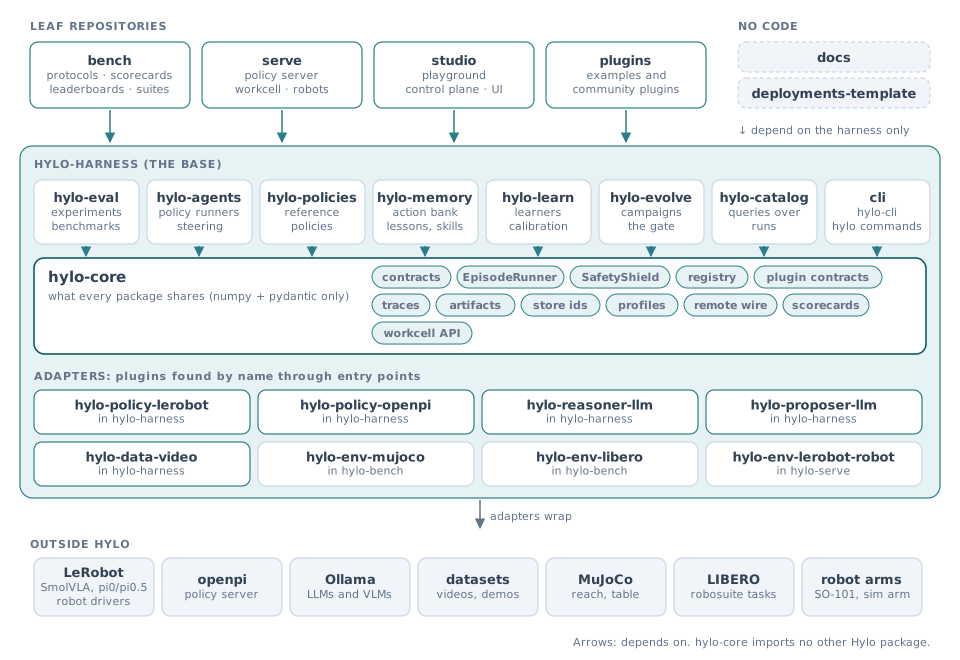
Contracts and the kernel in hylo-core; evaluation, agents, memory, learning and campaigns on top; adapters connect simulators, robots and policy stacks; the leaf repositories use all of it through the same formats.
Hylo is organised as a stack of six layers, all built on one execution kernel: kernel (hylo-core, plugins), runtime (hylo-serve), cognition (hylo-agents, hylo-memory, hylo-policies), evaluation (hylo-eval, hylo-bench), evolution (hylo-learn, hylo-evolve) and workbench (hylo-studio). The terms below belong to these layers; the home page has one card per layer.
Running
- Experiment config
- A YAML file (
hylo.experiment/v0.1,core.config.ExperimentConfig) naming a benchmark and split, an environment, an agent, and optionally safety limits, trace options, timing and a seed.hylo run CONFIGevaluates it. See experiments and the schema. - Digest
- A 16-hex-digit hash of what an experiment measures (
ExperimentConfig.measured()). Placement is left out: where results go (output_dir), how many workers, and where components run (env.remote, a remote agent'sruntime/python/env). So the same experiment has the same digest on a workstation, a GPU box and a robot computer, and two runs with the same digest are directly comparable. - Benchmark, task, split
- A benchmark (
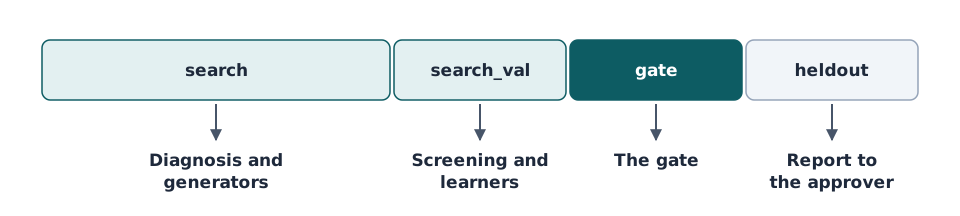
benchmarksplugin,core.benchmark.Benchmark) is a set of tasks plus named splits of their initial states (seeds). Thersiprotocol of RFC-0002 partitions init states into four splits with different readers:search(diagnosis; generators may read these traces),search_val(candidate selection),gate(confirmation, plusgate_r1, ... for further looks) andheldout(report only). Learners read onlysearchandsearch_val.
- Environment
- A simulator or a robot behind
core.env.Environment:spec(),reset(task),step(action),close(). The spec declares observation and action spaces, the action's control mode, the control rate and capabilities (for examplereal_robot). An environment may run in another process and venv (env.remote). - Agent
- What the kernel runs (
core.agent.Agent):spec(),reset(ctx),act(observation) -> ActionChunk,on_step(result),on_episode_end(outcome). Agents hold decision logic: running a policy, steering it, planning, using memory. - Policy
- The model inside an agent (
core.policy.ChunkPolicy,policiesgroup): given an observation,sample()draws action chunks, one per noise seed, shaped(N, T, A). Stochastic policies derive their randomness only from the seeds, so a candidate and its parent face the same noise on the same init state. See policies. - Action chunk
- A sequence of
Tactions predicted at once; the agent executesexecution_stepsof them before asking again. - Timing
- How policy time relates to robot time (
core.kernel.Timing).sync(default): the world waits for each policy call.realtime: the world keeps moving while the next chunk is computed, stale actions are dropped and a hold action fills gaps, on avirtualclock (deterministic, with a fixed or measured latency) or awallclock (a real control loop). One loop,core.kernel.EpisodeRunner, does both. - Safety shield
- The checkpoint between every agent and every environment (
core.safety.SafetyShield). A finite check runs first and a bounds clamp last; configured guards run in between. See safety. - Trace
- The event log of one episode (
core.trace): episode start, observations, proposed chunks, safety reviews, executed actions, step results, end. Scorers read traces only, so scoring never depends on the agent. - Run
- One evaluation of one split: a directory with
evallog.json(per-episode results and scores),manifest.json(config, digest, package versions, pinned store ids) and the episode traces.
Learning
- Artifact
-
Anything learned, sealed as a directory with an
artifact.jsonmanifest (hylo.artifact/v0.1,core.artifact): kind, content digest, and provenance (the builder and the runs it was built from). Roles decide how it is trusted:Role Examples Trusted when behaviouraction memory, critic, noise prior, policy weights the gate promotes a candidate that uses it instrumentsuccess judge, progress or world model it is calibrated against ground truth proposallesson book, skill library curated by outcome votes; only changes what is proposed dataan ingested external dataset it is labelled by its source or a calibrated judge - Store id
- The global name of a run or artifact in this machine's store:
run:<run_id>orartifact:<name>@<digest>. Configs reference artifacts by id; ids are resolved to local paths when a component is built. See store. - Learner
- A
learnersplugin that turns runs (and other artifacts) into one sealed artifact (Learner.fit(job)), driven by aTrainJobJSON (hylo learn). Learners read development splits only. See learning. - Judge, calibration
- A success judge (
instrumentsgroup) labels episodes without the simulator's ground truth. It is calibrated on runs whose outcome is known (hylo calibrate: AUC, precision and recall at a threshold), and only then used to label data (hylo label).
Improving
- Campaign
- Repeated improvement cycles on one experiment (
hylo.evolve/v0.1,hylo evolve run). Each cycle diagnoses the parent's search runs, asks a generator for candidates, evaluates them in a cascade and promotes at most one through the gate. See campaigns. - Generator, candidate
- A
generatorsplugin proposes candidates: config patches (dotted paths and values) with a hypothesis. Patches may not touch protected scopes (safety,benchmark,trace,scorers,evolution,schema_version,env). - Gate
- The confirmatory test that decides promotion: a paired test (McNemar by default) on the gate split, possibly over several group-sequential looks, with regression and safety vetoes. The held-out result is reported, never used for selection.
- Active version
- What a campaign currently deploys, written as
active.json(hylo.active/v0.1,core.deployment). A policy server can serve it (hylo serve policy --campaign DIR).
Benchmarking and deployment
- Protocol, scorecard, leaderboard
- A protocol (
hylo.protocol/v0.1, bench) fixes everything except the policy; its digest covers only what is measured. Running a policy under it gives a scorecard (hylo.scorecard/v0.1): success with a 95% Wilson interval and every episode. Leaderboards rank scorecards of one protocol. See benchmarking. - Policy server, workcell
- serve's two processes next to hardware. A policy server (
hylo serve policy) answers chunk requests over WebSocket. A workcell (hylo serve workcell) owns one robot or simulator, runs episodes with the realtime kernel, and takes operator input (stop, latched e-stop, reset confirmation, verdicts). See deployment. - Runtime, execution profile
- A runtime is a named interpreter plus environment variables on one machine (for example
libero-sim). The execution profile (hylo.profile/v0.1,~/.config/hylo/profile.yaml) lists them and the store location. Configs name runtimes, never paths. See profiles.
Extending
- Plugin, contract, maturity
- Everything that varies is a plugin registered under a
Hylo.<group>entry point. Each group is a versioned contract (hylo.policy/v0.1, ...); a package declares the version it implements and each plugin's maturity:implemented(run end to end on its target),unverified,needs-hardwareortest-double. The registry refuses an incompatible contract version. See the plugin catalogue and extending. - Test double
hylo.testingand thetesting.*plugins: a point-reach environment and simple agents for unit and conformance tests only. Every example, protocol and campaign runs on a real simulator.