Learning
Everything Hylo learns comes from recorded runs and becomes a sealed artifact: a directory with an
artifact.json manifest (hylo.artifact/v0.1) that records what it is, a content digest, and its provenance (the
builder, its parameters, and the runs and data it was built from). The trace store is the single source of truth;
artifacts are derived from it (RFC-0004).
Artifact kinds and roles
| Role | Kinds | Changes | Trusted when |
|---|---|---|---|
behaviour |
action_memory, value_model, noise_policy, policy_weights, policy_params |
what the robot does | the gate promotes a candidate that uses it |
instrument |
success_judge, progress_model, world_model |
what is measured or labelled | it is calibrated against ground truth |
proposal |
lesson_book, skill_library |
only what generators propose | outcome votes curate it |
data |
dataset |
what learners can read | its labels come from the source or a calibrated judge |
The gate's verdict never makes an instrument trustworthy, and calibration never activates a behaviour artifact: the two trust paths are separate.
The split guard
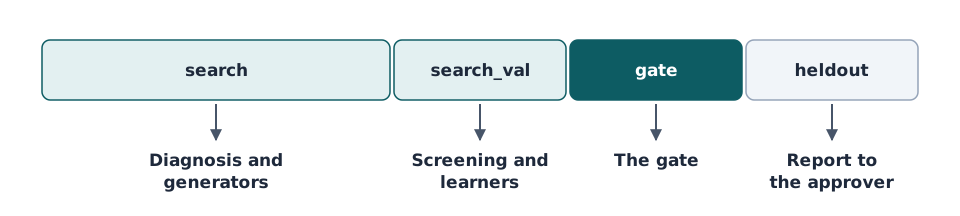
Learners read only the development splits. Gate and held-out runs are refused when a job starts, refused again when an artifact is sealed, and checked again by the gate for every artifact a candidate references.
TrainJob.splitsdefaults to("search", "search_val"); asking for agate*orheldout*split raisesSplitLeakbefore anything is read.- Learners collect inputs with
development_runs(), which skips other splits when scanning a directory and refuses them when given an explicit list. write_manifestrefuses to seal an artifact with a gate or held-out source.- Runs produced inside a learned model (world-model pre-screening) are never treated as training data unless a job
asks for the
syntheticsplit. - Ingested external data has split
external:<name>and is read only when a job includesexternal.
Run a learner job
A job names a learners plugin, its inputs, where to seal the artifact, and parameters:
{"learner": "policy.flow", "inputs": ["runs/policies/demos"], "out": "runs/policies/artifacts/flow",
 "params": {"chunk": 8, "epochs": 300, "integration_steps": 10}}
cd bench
uv run hylo learn examples/policies/jobs/flow.json
uv run hylo learn job.json --python bench/envs/libero/.venv/bin/python     # in another venv
| Field | Meaning |
|---|---|
learner |
a learners plugin name or module:attr |
inputs |
run directories, directories to search for runs, or store ids (run:<id>) |
out |
the artifact directory this job seals |
splits |
splits it may read (default search, search_val) |
params |
the learner's parameters |
A job is resumable: if out already holds a verified artifact sealed by the same job (the job digest covers
everything but out), it is not run again. --python runs the learner with another interpreter
(python -m hylo.learn.jobs), for learners whose dependencies live in a runtime's venv.
Learners that ship (see the plugin catalogue for maturity):
| Learner | Builds |
|---|---|
policy.knn, policy.bc, policy.flow, policy.tokens |
reference policies (policies) |
world_model.state |
a state world model (for policy.mpc and world-model pre-screening) |
critic.chunk_value |
a chunk critic for critic steering |
judge.trace |
a success judge from traces |
lerobot.action_memory, lerobot.noise_prior |
action memories and noise priors for LeRobot steering |
lerobot.expert_iteration |
fine-tuned LeRobot weights from successful episodes (unverified: smoke run only) |
Online learners (policy search that acts while it learns, for example the plugins repository's examples.cem) use
the same jobs; see extending.
Inspect and reference an artifact
uv run hylo artifact runs/policies/artifacts/flow     # verify (digest intact, no gate / held-out sources), print the manifest
uv run hylo store ref runs/policies/artifacts/flow    # its store id: artifact:policy.flow@<digest>
Configs reference artifacts by store id, never by path:
See store for ids, deletion protection and moving artifacts between machines.
Success judges and calibration
A success judge (instruments group) labels an episode from its trace when no simulator says whether it succeeded:
on a robot, or for external data. A judge is trusted only after calibration on runs whose outcome is known.
uv run hylo learn judge-job.json                                       # learner judge.trace -> a success_judge artifact
uv run hylo calibrate --judge '{"type": "judge.trace", "params": {"path": "artifact:l10-trace-v2@54a1efadf00d34d8"}}' \
    --runs RUN_DIR [RUN_DIR ...] --artifact JUDGE_DIR      # JUDGE_DIR: the judge's artifact directory
Calibration reads development splits by default (--splits) and compares the judge's scores with the simulator's
outcomes. It reports AUC, Brier score, expected calibration error, and the lowest threshold that reaches the target
precision (--target-precision, default 0.95) with the recall there. The judge is ready to label when enough
episodes were scored (at least 50), the target precision is reachable, and the recall at that threshold is at least 0.3. With
--artifact, the judge's own training runs are excluded and the report is stored in the judge's manifest.
| Judge (LIBERO-10) | AUC | Precision / recall at the 0.95-precision threshold | Ready to label |
|---|---|---|---|
judge.trace |
0.93 | 0.95 / 0.55 (threshold 0.994) | yes |
judge.vlm |
0.61 | 1.00 / 0.13 (threshold 0.95) | no |
From this project's experiment record (success judges on LIBERO-10).
External data
Demonstrations, videos and other robots' logs enter as ordinary runs with split external:<name>, sealed as data
artifacts that record origin and licence:
uv run hylo ingest spec.json          # {"source": {"type", "params"}, "name", "licence", "out", "image_every", "assume_success"}
uv run hylo label RUN_DIR --judge bench/runs/judges/l10-trace-v2     # label unlabelled episodes with a ready judge
uv run hylo contamination EXTERNAL_RUN --protected bench/runs/rsi-libero10/runs
hylo labellabels only ingested runs, only with areadyjudge, at no less than its calibrated threshold, and never runs the judge was built from. An episode below the threshold stays unlabelled; a low score is never called a failure.hylo contaminationcompares each external episode's initial state with the initial states of protected (gate and held-out) episodes of the same task. External data that reproduces protected init states must not be used to build anything that is then gated on them.
Data sources are datasources plugins: video.frames and video.files (hylo-data-video) and lerobot.dataset
(hylo-policy-lerobot, unverified here: dataset downloads have not been approved yet).