Improvement campaigns
A campaign improves an experiment's agent by repeated, gated changes to its config. Each cycle diagnoses the current version (the parent), asks a generator for candidate patches, evaluates them in a cascade on fresh init states, and promotes at most one, only when a confirmatory paired test on yet other init states says it is better. A held-out split that no decision ever reads reports the result. This is the RFC-0002 protocol (RFC-0002).
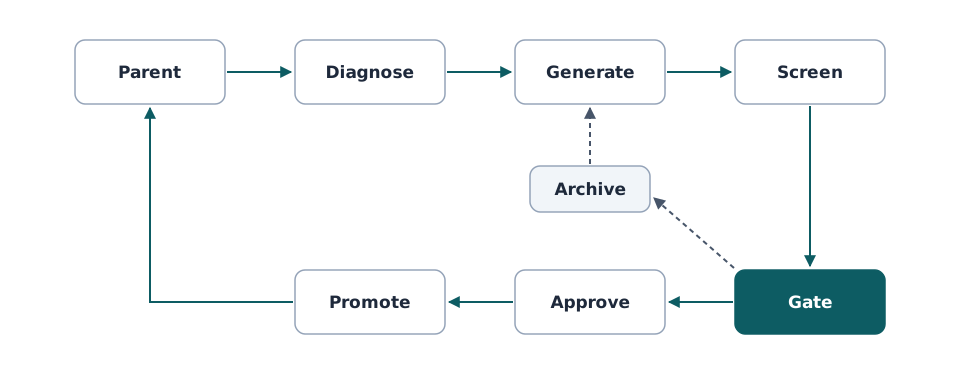
One cycle: diagnose the parent on search, propose, check at stage 0, select on search_val, confirm on gate,
report on heldout, approve, promote. The promoted candidate is the next cycle's parent.
Run a campaign
uv run hylo evolve run bench/examples/evolve/mujoco_reach_gain.yaml      # out_dir (runs/...) is relative to here
uv run hylo evolve status bench/examples/evolve/mujoco_reach_gain.yaml
schema_version: hylo.evolve/v0.1
name: mujoco-reach-gain
experiment: ../configs/mujoco_reach.yaml
experiment_overrides: {agent.params.kp: 0.02, workers: 16, benchmark.params: {protocol: rsi, gate_looks: 2}}
proposer: {type: rule.gain, params: {path: agent.params.kp, factors: [2.0, 4.0]}}
protocol: {alpha: 0.05, gate_looks: 2, stage1_pairs: 20}
cycles: 3
stop_after_no_progress: 1
approval: auto
out_dir: runs/evolve/mujoco-reach-gain
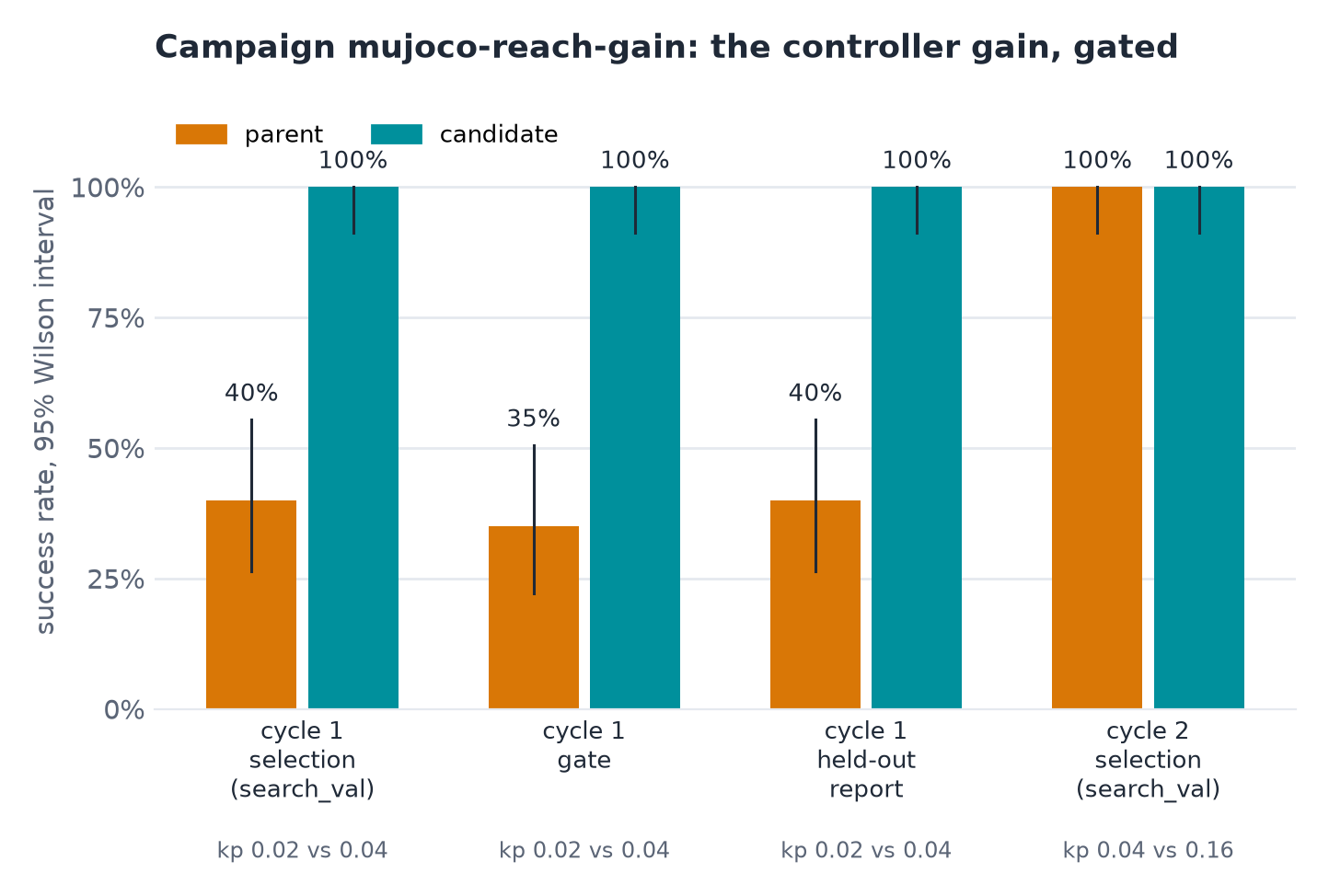
This campaign on this project's workstation: in cycle 1 the parent (kp: 0.02) succeeds on 0.40 of the held-out
episodes, the promoted candidate on 1.00 (24 wins, 0 losses over 40 pairs, p = 6e-8). Cycle 2 finds nothing better
and the campaign stops.
hylo evolve run resumes an interrupted campaign from its state file; --set KEY=VALUE overrides the campaign config.
| Key | Default | Meaning |
|---|---|---|
experiment |
required | the experiment config to improve (a relative path is resolved against the campaign file) |
experiment_overrides |
{} |
dotted-path overrides applied to it, typically benchmark.params.protocol: rsi |
proposer |
rule.steering |
the generator ({type, params}) |
diagnosis |
{} |
options for reading the parent's failures (for example stall_steps, regrasp) |
protocol |
see below | the gate protocol |
cycles |
1 | maximum cycles |
stop_after_no_progress |
2 | stop after this many consecutive cycles without a promotion |
budget_s |
none | wall-clock budget for the campaign |
approval |
auto |
manual: a candidate that passes the gate waits for hylo evolve approve |
out_dir |
runs/evolve |
the campaign directory |
Splits
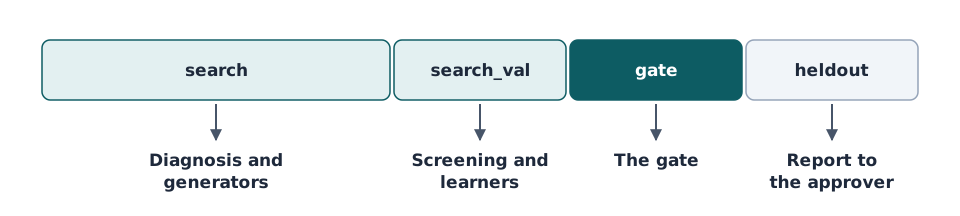
The benchmark must provide the four RFC-0002 splits (benchmark.params.protocol: rsi). Each has one reader:
| Split | Read by | Used for |
|---|---|---|
search |
diagnosis and generators (they may read these traces) | finding what fails |
search_val |
the cascade | selecting candidates; metrics are never shown to the generator |
gate, gate_r1, ... |
the gate | one confirmatory paired test per look |
heldout |
nobody | reporting the promoted candidate against its parent |
Learners read only search and search_val (learning). MuJoCo reach's rsi protocol
uses 100 seeds starting at 30000 (40 / 20 / 20 / 20 percent); LIBERO's uses the 50 stored init states of each task,
split 20 / 10 / 10 / 10 (rsi_bounds, default [20, 30, 40]), with noise replicates for more gate looks.
The cascade and the gate
| Stage | On | What happens |
|---|---|---|
| 0 | nothing run yet | protected scopes, schema, novelty (not already archived), referenced artifacts (sealed, unmodified, no gate or held-out sources, no unknown provenance for behaviour artifacts), optional world-model pre-screen |
| 1 | the first stage1_pairs of search_val |
early rejection when the parent leads by more than stage1_max_deficit wins |
| 2 | all of search_val |
selection: the best gate_top_k candidates go on |
| 3 | gate, then gate_r1, ... |
a paired test against the parent (McNemar on success by default), Holm-corrected across candidates, with group-sequential looks and futility stopping; regression and safety vetoes |
| report | heldout |
candidate vs parent, paired; recorded with used_for_selection: false |
protocol (evolve.protocol.ProtocolConfig):
| Key | Default | Meaning |
|---|---|---|
alpha |
0.05 | family-wise error rate of the gate |
stage1_pairs |
10 | pairs used for early rejection |
stage1_max_deficit |
2 | reject if parent wins exceed candidate wins by this much in stage 1 |
gate_top_k |
1 | candidates confirmed on the gate (Holm-corrected) |
gate_looks |
1 | group-sequential looks (the benchmark must provide gate_r1, ...) |
spending_rho |
3.0 | alpha spent by look k: alpha * (k/K)^rho (close to O'Brien-Fleming) |
futility_stop |
true | stop a candidate once it no longer leads the parent on the gate |
max_task_regression |
0.15 | veto: success on any task may not drop by more than this |
max_safety_increase |
1.0 | veto: mean safety interventions may not rise by more than this |
max_candidates |
8 | candidates evaluated per cycle |
budget_s |
none | wall-clock budget per cycle |
prescreen |
none | {env: {type: world_model, params: {path}}, split, margin}: reject candidates a world model predicts below parent - margin before any real rollout |
gate_test |
{type: mcnemar} |
the paired statistic (gate_tests plugin), for example {type: sign, params: {metric: steps, direction: lower}} |
Candidates and parents share seeds and noise (seeded policies), so every comparison is paired: the same init state, the same noise, two configs.
Generators
A generator (generators group) reads the diagnosis, the parent config and the archive and returns candidates:
config patches with a hypothesis. Patches may not touch safety, benchmark, trace, scorers, evolution,
schema_version or env.
| Generator | Proposes | Maturity |
|---|---|---|
rule.gain |
scaled values of one numeric config path | implemented |
rule.steering |
steering rules (resample, back off) from failure buckets such as stalls and regrasps | implemented |
llm.steering |
steering patches from a local LLM reading failure traces (hylo-proposer-llm, Ollama) | implemented |
learn |
trains an artifact with a learner each cycle and patches the config to use it ({artifact} in the patch template becomes its store id) |
unverified |
critic.chunk_value |
trains a chunk critic and proposes critic steering | unverified |
experience |
lessons and skills mined from the archive | unverified |
selftrain.expert_iteration |
fine-tunes the policy on its own successes | unverified (smoke run only) |
Unverified means tested but not yet run end to end in a campaign here; see the
plugin catalogue. Write your own with hylo plugin new generator NAME.
What a campaign leaves behind
runs/evolve/mujoco-reach-gain/
  evolve_config.json        the config as run
  campaign_state.json       cycles done, history, why it stopped
  archive.jsonl             every candidate: patch, hypothesis, stages reached, verdict, evidence
  registry/                 promotion ledger (ledger.jsonl) and the active candidate (ACTIVE)
  active.json               the active version, resolved to an agent spec (hylo.active/v0.1)
  cycle-01/                 the cycle's runs and cycle_report.json
  pending_approval.json     only while a candidate waits for manual approval
Archive verdicts: rejected (stage 0 or 1), archived (evaluated on search_val, not sent to the gate),
gated_fail (the gate did not confirm it), gate_passed (confirmed, not promoted), promoted. Store ids and paths in the archive and ledger protect the runs and artifacts they name from deletion
(store).
Approve, roll back, shadow
uv run hylo evolve approve runs/evolve/my-campaign          # recorded with your user name
uv run hylo evolve rollback runs/evolve/my-campaign --reason "regression seen on the robot"
uv run hylo evolve status runs/evolve/my-campaign --publish        # also (re)write active.json
uv run hylo evolve shadow runs/evolve/my-campaign --candidate cand-9147236d7d
- With
approval: manual, a candidate that passes the gate is parked inpending_approval.jsonand the campaign stops until someone approves it. Use manual approval for anything that runs on hardware. rollbackrestores the parent of the active version and records who did it and why (--reason) in the ledger.- The target may be the campaign config or the campaign directory; run these from the directory the campaign ran in, since the experiment path inside is relative.
shadowruns the active version with the candidate riding along: the candidate sees every observation but never acts, and the report says how often and how far it would have acted differently. This is the step before trying a candidate on a robot.- A policy server started with
hylo serve policy --campaign DIRfollowsactive.jsonand switches versions between sessions, never during one (deployment).
Studio shows campaigns, their archives and pending approvals, and lets an approver approve or roll back (studio).
LIBERO-10 campaigns
bench/examples/evolve/ has campaigns on frozen SmolVLA in LIBERO-10: libero10_steering.yaml (rule-based
steering), libero10_llm.yaml (an LLM proposes steering) and libero10_selftrain.yaml (expert iteration). They need
the LIBERO setup and take hours on CPU (budget_s: 28800). Results so far are in the
experiment records.